
Building a genuine connection with a cat is rarely as straightforward as new owners imagine. Unlike dogs, who often wear their hearts on their paws, cats reveal affection in quieter, more deliberate ways. A slow blink across the room, a gentle head bump, or simply choosing to nap in the same sunbeam can all be profound signs of trust. For many people, the gap between expectation and reality creates frustration—they assume a cat is aloof when, in reality, the human simply hasn’t learned the cat’s language.
Shifting expectations around cat companionship also play a role. More owners now work from home, adopt older rescues, or share space with multi-cat households, all of which influence how quickly a bond forms. Understanding feline social wiring isn’t about bending a cat to your will; it’s about curating an environment where closeness develops organically. The following veterinarian-backed strategies translate decades of behavioral science into daily habits that turn polite coexistence into a warm, trusting relationship.
In This Article
- Why a Strong Bond Benefits Both You and Your Cat
- 10 Vet-Reviewed Tips to Deepen Your Connection
- Reading Feline Body Language Correctly
- Common Bonding Mistakes That Can Erode Trust
- When a Distant Attitude Might Signal a Health Issue
- Building a Routine That Reinforces Security
Why a Strong Bond Benefits Both You and Your Cat
A secure bond does more than satisfy emotional needs—it actively contributes to better veterinary outcomes and lower stress for the entire household. Cats who trust their owners are easier to handle during nail trims, medication administration, and car rides, which means routine care becomes less traumatic for everyone. Veterinary behaviorists frequently note that bonded cats exhibit more relaxed postures during examinations, allowing for earlier detection of subtle health changes.
From a human perspective, the rhythmic purr of a contented cat has been associated with reduced cortisol levels and a calming effect on the nervous system. The relationship becomes a feedback loop: as the cat feels safer, the owner feels more rewarded, which in turn motivates more positive interactions. This dynamic is especially critical for rescue cats or previously traumatized animals that need consistent, predictable signals to rebuild their capacity for trust.
10 Vet-Reviewed Tips to Deepen Your Connection

1. Respect the Power of the Slow Blink
In feline body language, a prolonged, deliberate blink directed at another being signals relaxation and non-aggression. Try catching your cat’s gaze from across the room, then slowly close your eyes for a second or two before opening them softly. Many cats will mirror the gesture. This mutual exchange releases tension and tells the cat you are not a threat. Avoid staring intently without blinking, which reads as confrontation.
2. Let the Cat Initiate Physical Contact
Extending a hand toward a cat’s face, especially from above, can feel invasive. Instead, crouch to the cat’s level and offer a loosely curled finger at nose height. Allow the cat to step forward, sniff, and decide whether to rub against you. When a cat initiates touch—rubbing cheeks, bumping foreheads, winding between ankles—the interaction floods both parties with bonding hormones.
3. Play as a Shared Language
Predatory play isn’t just exercise; it’s an emotional outlet. Wand toys that mimic the erratic movement of prey engage a cat’s stalking sequence and build trust because you become a cooperative hunting partner. Veterinarians recommend two or three short play sessions daily, ending each with a small treat or meal to complete the “catch” cycle. This predictable rhythm reduces anxiety and channels energy that might otherwise become destructive.
4. Talk in a Soft, Consistent Voice
Cats are highly attuned to auditory cues. A calm, slightly higher-pitched voice (not baby talk, but gentle) paired with the cat’s name builds positive associations. Many owners underestimate how much a cat learns to recognize specific words—like “treat,” “play,” or “bedtime”—when delivered with predictable warmth. Narrating actions before they happen, such as “I’m going to pick up the brush now,” lowers startle responses.
5. Create Vertical Safe Zones
Height equals security in the feline mind. Installing cat trees, window perches, or sturdy shelves gives a cat controlled vantage points from which to observe household activity without feeling cornered. A cat who can retreat upward when overwhelmed is far more likely to return and engage on its own terms. This environmental enrichment communicates respect for the cat’s need for autonomy.
6. Scent-Mark Together
Cats have scent glands on their cheeks, paws, and the base of the tail. When your cat rubs against your legs or furniture, it is depositing familiar pheromones that define a safe territory. You can reciprocate by placing a soft, well-worn piece of your clothing near the cat’s favorite sleeping spot. The intermingling of scents reinforces a shared group identity that is central to feline social structure.
7. Hand-Feed a Few Morsels Daily
Offering a small portion of the cat’s regular meal or a healthy freeze-dried treat directly from your hand bypasses fear and links your presence to a primal positive experience. Start by placing the food on the floor beside you, then gradually move it onto your palm. This is especially effective with shy or newly adopted cats who are still mapping out which humans feel safe.
8. Master the Art of Doing Nothing
Sometimes the fastest way to bond is to sit quietly on the floor, reading or scrolling, while the cat explores the room around you. The absence of expectation is itself a bonding agent. A cat who learns that your presence doesn’t automatically mean being grabbed or chased will begin to view you as a source of ambient safety.
9. Groom Gently and Watch for Signals
Many cats bond intensely over grooming, but the session must respect their tolerance threshold. Begin with a soft brush on the cheeks and neck—areas where cats naturally allogroom—and pause frequently to check for signs of overstimulation: twitching skin, tail thumping, or pinned ears. A single three-minute session that ends on a positive note is worth more than a ten-minute session that finishes with a bite.
10. Keep the Litter Box and Feeding Stations Stable
Environmental stability underpins emotional readiness for bonding. Cats are territorial creatures who interpret frequent changes in their core resources as threats. Maintaining clean litter boxes in quiet, predictable locations and feeding at the same times each day builds the foundational trust that makes all other bonding interventions possible. A cat living with chronic low-grade environmental stress will not have the bandwidth to invest in a social relationship.
Reading Feline Body Language Correctly
Misreading a cat’s stress signals is one of the most common reasons bonding stalls. A swishing tail, for example, is not a sign of happiness; it indicates mental arousal that can quickly escalate to overstimulation if petting continues. Flattened ears signal fear or irritation, while ears rotated slightly back often mean uncertainty. The cat’s whole body communicates constantly, and tuning into these cues allows an owner to pause or redirect before trust erodes.
| Behavior | What It Signals | Recommended Response |
|---|---|---|
| Slow blink with softened eyes | Relaxation, trust | Return the slow blink, speak softly |
| Tail straight up with a slight curl at the tip | Friendly greeting, confidence | Acknowledge with gentle words, offer a hand |
| Ears flat against the head | Fear, defensive aggression | Step back, remove stressors, allow escape |
| Purring while body is tense | Possible pain or stress (also contentment) | Assess context; if at vet or after a fall, seek care |
| Belly exposed | Deep trust, but not always an invitation | Never rub the belly unless the cat has a clear history of enjoying it |
Common Bonding Mistakes That Can Erode Trust
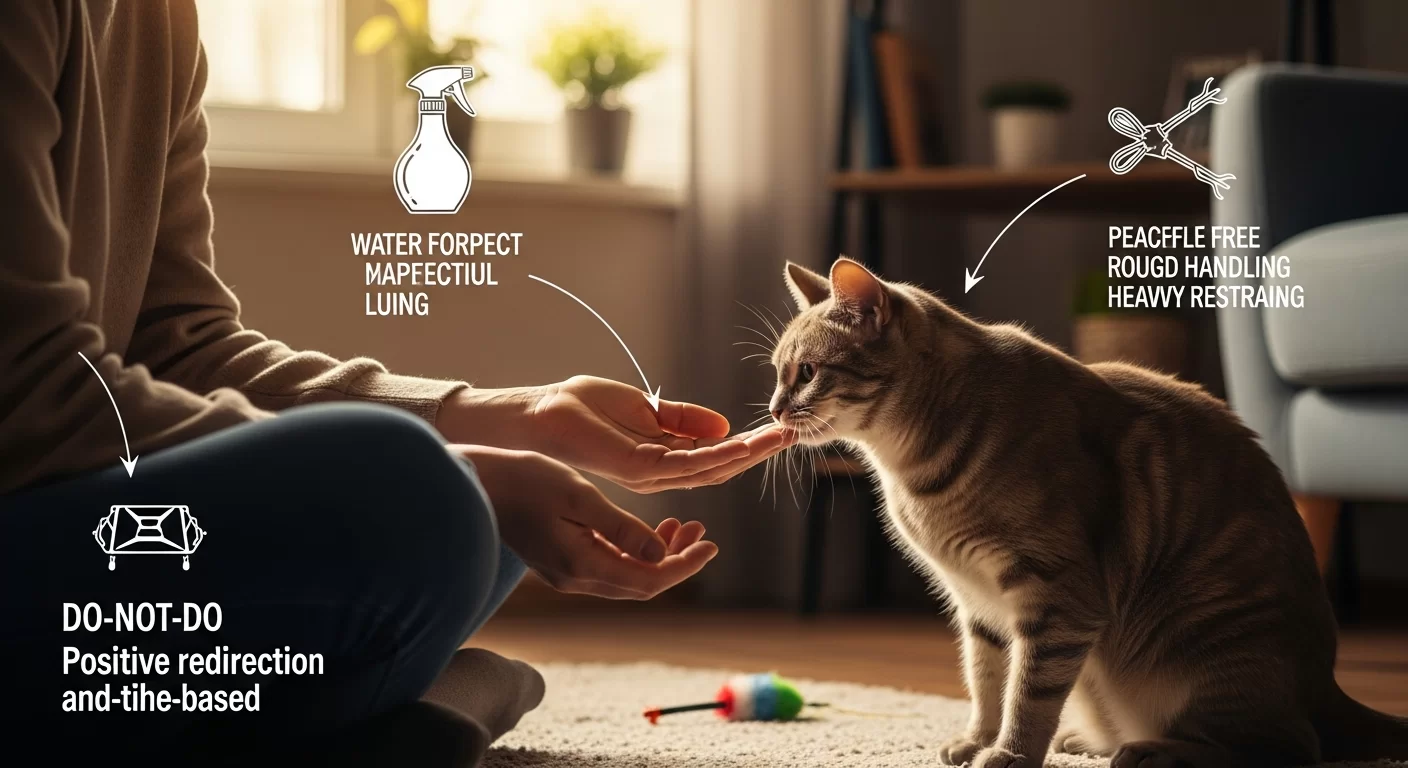
Picking up a cat against its will. Many cats feel restrained rather than soothed when lifted. If a cat struggles, tighten your arms only briefly, then gently release. Reward calm feet-on-floor moments instead.
Using punishment. Spritzing water, shouting, or swatting breaks the bond because the cat connects the aversive experience to you, not to the unwanted behavior. Redirection with a toy or scratching post is far more effective and preserves trust.
Ignoring consent during petting. Rough petting along the back or base of the tail can trigger a bite reflex. Paying attention to the cat’s “enough” signals teaches the cat that you are a safe, respectful companion.
Staring contests. Prolonged direct eye contact without blinking is how cats challenge adversaries. A cat who looks away first isn’t being sneaky; it is attempting to defuse what it perceives as a threat.
When a Distant Attitude Might Signal a Health Issue
If a normally sociable cat suddenly becomes withdrawn, hides excessively, or hisses when touched, a veterinary visit is critical. Pain—from dental disease, arthritis, or urinary tract conditions—can express itself as irritability or avoidance long before other symptoms appear. Hyperthyroidism can cause restlessness and aggression, while cognitive decline in senior cats may lead to disorientation and decreased social engagement. Treating the underlying condition often restores the cat’s desire for closeness. Reputable veterinary behaviorists, including those at the American Association of Feline Practitioners, emphasize that abrupt behavioral shifts should never be dismissed as mere moodiness.
Building a Routine That Reinforces Security
Cats are creatures of habit, and a predictable daily rhythm builds the emotional scaffolding for attachment. Feeding, play, quiet companionship, and rest should occur in a consistent sequence. When a cat learns that you will reliably show up at certain times with positive interactions, its brain releases dopamine in anticipation. Over time, this anticipation wires you directly into the cat’s sense of safety and well-being. The goal isn’t to train a cat like a small dog, but to weave yourself so seamlessly into its environment that your presence becomes synonymous with comfort, choice, and gentle understanding. That slow, steady approach transforms a shared address into a genuine home.