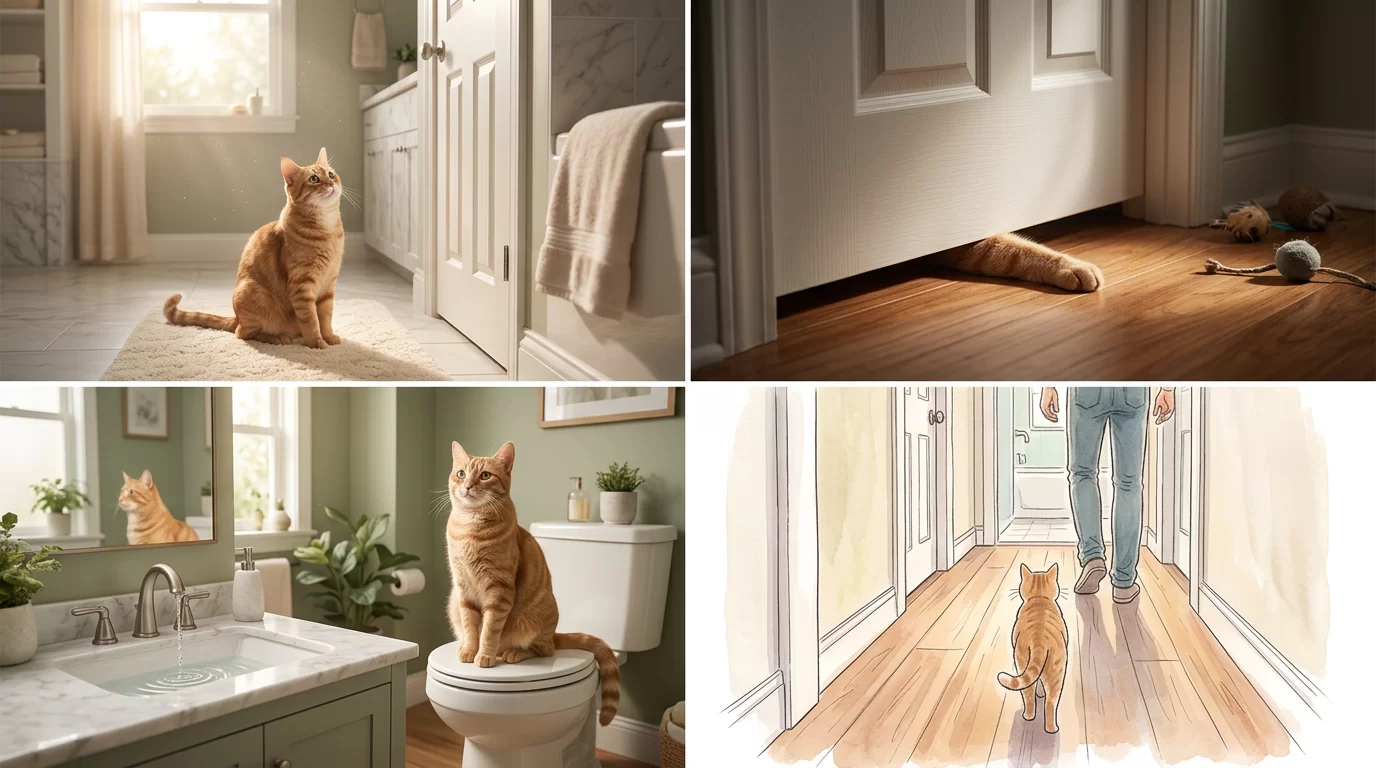
Few behaviors are as universally recognized by cat owners as the determined march a feline makes toward the bathroom door the moment it clicks shut. What begins as a private moment quickly becomes a negotiation of space, with paws reaching under the door, soft chirps filling the hallway, or a quiet, dignified wait on the bath mat. To a human, this habit can feel equal parts flattering and intrusive—a daily reminder that privacy is a concept cats simply do not honor. Yet behind this seemingly quirky ritual lies a rich layer of behavioral ecology, territorial psychology, and social bonding that explains why the bathroom becomes a magnet for feline attention. Understanding this dynamic shifts the narrative from “my cat is clingy” to a more accurate portrait of a species hardwired to track boundaries, maintain proximity, and participate in the rhythms of its social group.
In This Article
- A Direct Answer to the Bathroom Escort Question
- The Behavioral Ecology of Feline Boundary Tracking
- Affection, Guarding, or Routine: Decoding the Motivation
- When Bathroom Following Signals an Underlying Issue
- Practical Ways to Manage the Behavior Gently
- What Your Cat’s Loyal Shadow Really Means
A Direct Answer to the Bathroom Escort Question
Cats follow their owners to the bathroom primarily because the behavior blends territorial monitoring, social bonding, and a low-risk opportunity to engage in predictable interaction. In a multi-cat household or a solitary apartment, the bathroom represents a distinct boundary zone—often featuring a door that disrupts visual contact, a tight space rich with familiar scent, and an owner who suddenly becomes stationary and available. For a species that relies on scent communication and routine, the bathroom run is rarely random. It is a ritualized tracking pattern, sometimes called boundary tracking, where the cat’s instinct to monitor the edges of its perceived territory kicks in. Add the fact that cats learn quickly: following the human to the bathroom often results in undivided attention, a warm lap on the toilet lid, or a dripping faucet to inspect. The payoff is immediate and reinforcing. In short, your cat escorts you not because it fears you will escape out the window, but because the bathroom, in feline logic, is a fascinating nexus of territory, scent, and social opportunity.
The Behavioral Ecology of Feline Boundary Tracking
Ethologists describe boundary tracking as a natural extension of how cats patrol and define their home range. In outdoor colonies, cats regularly move along the edges of their territory, checking scent marks and observing entry points. The bathroom door interrupts that patrol pattern inside the home. To a cat, a closed door does not represent privacy—it represents an anomaly that prevents the completion of a mental map. The space beyond the door is part of the cat’s territory, and losing visual and olfactory access to both the room and the human inside can create a mild but persistent motivation to investigate.
This drive is amplified by resource awareness. Cats are obligate observers; they feel safest when they can monitor the movements of their social partners. The bathroom, with its lack of escape routes and its predictable sounds, becomes a location where a cat chooses to post up simply to keep its human in view. It is less about separation anxiety in the clinical sense and more about the cat’s preference for environmental completeness. When the door is left ajar, many cats will enter, do a brief perimetry check, and either settle down or leave—their patrol complete.
Affection, Guarding, or Routine: Decoding the Motivation
Not all bathroom escorts operate from the same playbook. Recognizing the variety of motivations can help owners respond appropriately. The following table breaks down the most common drivers behind the behavior.
| Motivation | Typical Signs | What It Reflects |
|---|---|---|
| Social bonding | Purring, slow blinking, rubbing against legs, curling up on the mat. | The cat views you as a core member of its social group and seeks proximity during idle moments. This often mirrors how bonded cats rest near each other in colonies. |
| Opportunistic attention | Meowing, pawing at the door, jumping onto the sink to nudge your hand. | The cat has learned that the bathroom offers a captive audience. The behavior is goal-oriented, not distress-driven. |
| Territorial monitoring | Patrolling the room, sniffing corners, staring at the door or window. | The bathroom is treated as a frontier zone. The cat is checking for changes or intruders, a remnant of wild boundary defense. |
| Routine fixation | Following at the exact same time daily, meowing if the schedule shifts. | Cats are temporal creatures. The morning bathroom visit becomes a predictable event, and disruption causes low-level frustration. |
| Instinctive guarding | Sitting or standing between you and the door, alert posture, scanning. | In a quiet home, the cat may adopt a loose guarding role during vulnerable moments, a behavior seen in social species that take turns watching for danger. |
For most cats, bathroom following is a blend of social bonding and routine. The cat might genuinely enjoy the quiet, one-on-one time that lacks the hustle of other parts of the home. Much like the rhythmic comfort of cat kneading blankets, the bathroom ritual can become a self-soothing pattern, particularly if the cat associates the space with warmth and the sound of running water.
When Bathroom Following Signals an Underlying Issue
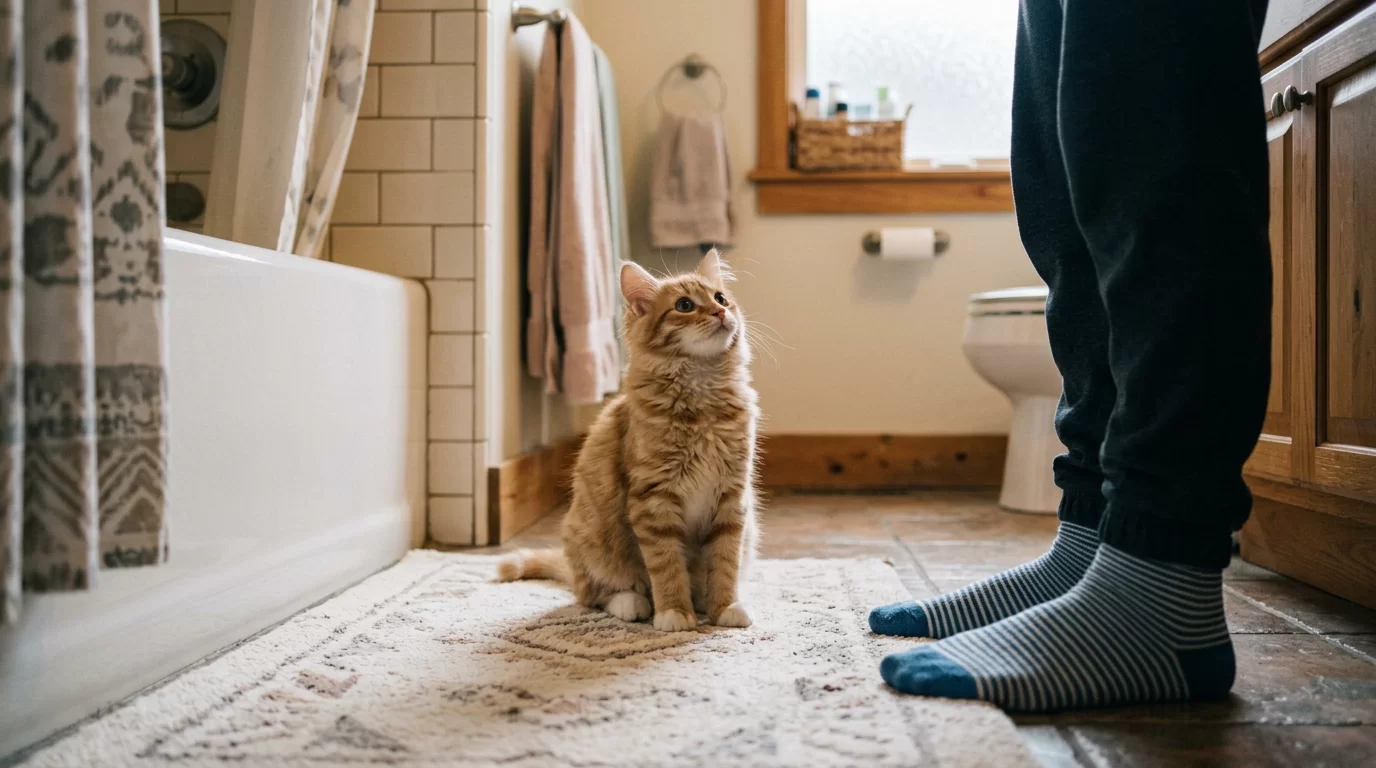
Physical discomfort can also turn up the dial. A cat dealing with cognitive decline, fading vision, or hearing loss may rely more heavily on an owner’s presence to navigate the environment. In these cases, the following behavior is a coping strategy, not a quirk. Owners should note whether the bathroom shadowing is accompanied by signs like loss of appetite, excessive vocalization at night, or litter box avoidance. Consulting a veterinarian or a board-certified veterinary behaviorist is the recommended step when the behavior is new, sudden, or paired with other red flags.
Practical Ways to Manage the Behavior Gently
For owners who would prefer to use the bathroom without an audience, the goal is not to extinguish the cat’s curiosity but to redirect it without damaging the bond. Punishment or forceful removal is counterproductive and can increase anxiety. Instead, environmental management and alternative enrichment work best.
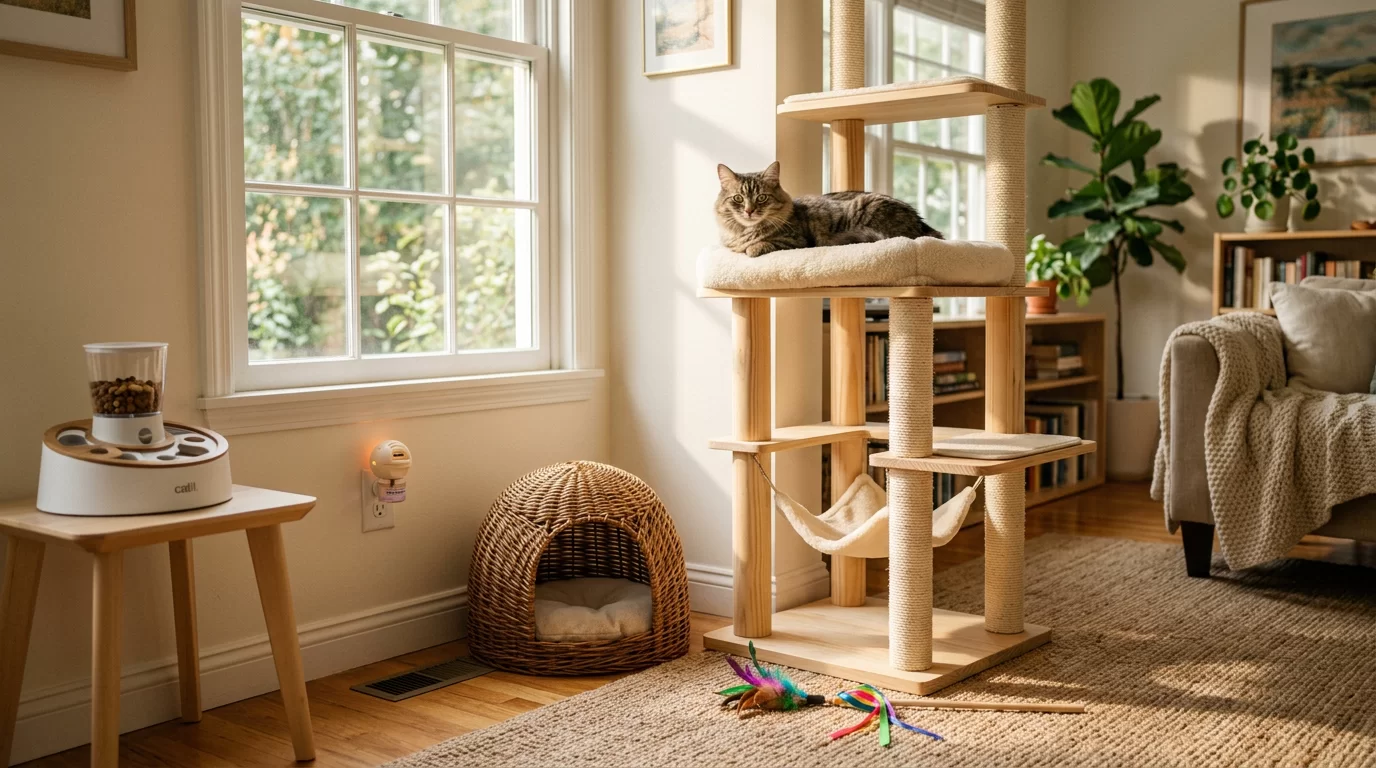
Create a positive distraction station. About five minutes before your usual bathroom routine, place a puzzle feeder or a treat-dispensing toy in another room. Over time, the cat learns that the human’s bathroom schedule triggers a rewarding solo activity elsewhere.
Offer a dedicated bathroom perch. If space allows, a small cat bed on a shelf or a heated mat in a corner gives the cat a designated spot that feels safe. The cat still shares the space, but the interaction becomes passive rather than demanding.
Satisfy the patrol need earlier. A brief play session that includes entire-home walking—from the front door to the back rooms—can reduce the urgency of boundary checking. When the cat has already circuit-patrolled the territory with you, the bathroom door closing registers as less of an interruption.
Use scent anchors. A worn piece of clothing placed on a cat bed outside the bathroom provides olfactory reassurance. The message is clear: “You are still part of this social unit even without direct visual contact.”
For cats that become distressed by the sound of water or the bathroom fan, desensitization protocols using gradual exposure and high-value rewards can be effective. Working with a feline behavior professional ensures the plan fits the individual cat’s temperament.
What Your Cat’s Loyal Shadow Really Means
If the bathroom escort is a daily ritual rather than a source of distress, it is almost always a sign of a secure, invested relationship. Cats do not waste energy tracking individuals they consider irrelevant. The behavior reflects a level of social investment that parallels how bonded cats in colonies synchronize their resting and patrol periods. When a cat chooses to sit on the vanity while you brush your teeth, it is engaging in a quiet form of group cohesion—a behavior that loosely translates to “our schedules are aligned, and I am content here with you.”
This same social language appears in other behaviors owners find puzzling. The solicitation purr, a specific high-pitched purr that cats deploy when asking for food or attention, is another example of how cats manipulate shared space and sound to strengthen the human-cat bond. While the bathroom escort lacks the urgency of a solicitation purr, it shares its foundation: a cat adapting its natural social instincts to the architecture of a human home.
Recognizing this allows owners to reframe the bathroom visit not as an intrusion but as a daily affirmation of trust. The cat does not see a door; it sees a gap in the patrol route that it would prefer to keep open. And in a species that values predictability above all else, the human who reliably stays put on the other side of that barrier is worth waiting for.
In a world that often feels unpredictable, a cat’s quiet insistence on being near its person, even in the smallest room in the house, is a remarkably honest form of companionship. It asks for nothing more than a few seconds of acknowledgment and maybe a drip of water from the faucet. The bathroom may not be the throne room of the home, but for a cat, it is squarely within the heart of its territory—and you are at the center of it.